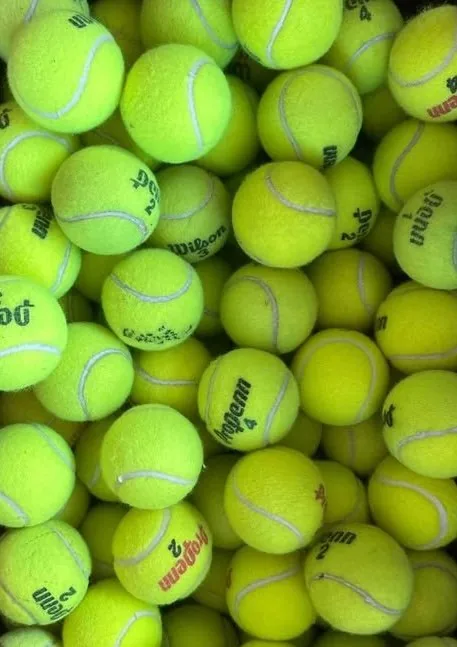
Every dog owner knows a tennis ball's second career well — it gets a little fuzzier, a little flatter, and eventually ends up buried in the yard or lost under the couch. But before a ball ever reaches a dog, millions of them are already being thrown away by the tennis world itself, usually after just a few sets of competitive play. Multiply that out across clubs, tournaments, and everyday players, and the scale gets surprisingly large.
The Numbers Behind the Problem
A few figures put this in perspective:
- 330 million tennis balls are produced globally every year.
- 125 million of them end up in U.S. landfills annually.
- Only about 1% are ever recycled.
- A single tennis ball can take 400+ years to decompose.
That last number is the one that tends to stop people. A ball that gets tossed after a single tournament weekend will still be sitting in a landfill when your great-great-great-grandchildren are grown. Multiply one ball's 400-year timeline by 125 million balls a year, and the backlog only grows.
Why Tennis Balls Are So Hard to Recycle
It is not that no one has thought to recycle tennis balls — it is that a tennis ball is a genuinely difficult object to take apart. Each one is built from several bonded materials: a pressurized rubber core wrapped tightly in a wool-and-nylon felt. Standard curbside recycling equipment is designed to sort single materials — paper, glass, specific plastics — and a tennis ball's mixed, bonded construction does not separate cleanly on that equipment.
That is why most curbside programs will not accept them, and why tossing one in your recycling bin can actually create more problems than it solves, by tangling equipment or contaminating a batch of otherwise-recyclable material. A tennis ball that goes in the trash or the recycling bin is, in either case, very likely headed for a landfill.
What Actually Happens to a Retired Ball
In competitive tennis, a ball is usually retired for losing just a little pressure and bounce — long before the felt wears through or the rubber core fails. That means the vast majority of retired balls still have real life left in them. They are not broken. They are simply no longer precise enough for tournament-level play.
Left alone, a retired ball's most likely path is the trash, then a landfill, where it will sit largely unchanged for centuries. Its most useful path is a second life — as a dog toy, a classroom chair-leg cover, a training aid, or a household fix. The difference between those two outcomes is almost entirely about whether someone takes the extra step to redirect the ball before it reaches the bin.
Why this isn't a guilt trip
None of this is about feeling bad for playing tennis or buying new balls. It's about one simple swap: instead of a retired ball's last stop being a landfill, it becomes a dog's new favorite toy. Small habit, real difference, no lifestyle change required.
Giving Tennis Balls a Second Life
This is exactly the gap Bark Balls was built to close. We collect retired tennis balls from clubs, tournaments, schools, and individual players, inspect and repackage the usable ones, and send them out as affordable dog toys — keeping them in circulation instead of in a landfill. A portion of every sale also supports animal shelters, humane societies, and environmental causes.
If you have a stash of retired balls sitting in a garage, a court storage closet, or a tournament's leftover bin, there are two easy ways to send them our way:
- Fetch Forward™ — for individual players and ball collectors. Box up your dry, intact balls and ship them to us.
- Court-to-Canine — for clubs, schools, universities, and other facilities looking for an ongoing collection partnership. Tournaments can partner with us through our Tournaments page.
Full details, current pricing, and instructions are always on our Fetch Forward page.
Frequently Asked Questions
How long does it take a tennis ball to decompose?
Estimates put it at 400+ years, due to the bonded rubber-and-felt construction that resists breaking down in a landfill environment.
How many tennis balls end up in landfills each year?
Around 125 million tennis balls enter U.S. landfills annually, out of roughly 330 million produced globally each year.
Can tennis balls be recycled curbside?
Almost never. Their mixed rubber-and-felt construction doesn't separate cleanly on standard recycling equipment, so most curbside programs don't accept them. Reuse and donation are better options.
What percentage of tennis balls actually get recycled?
Only about 1%, by most estimates — the rest are landfilled, stored, or thrown away.
What can I do with my own retired tennis balls?
Donate them. Organizations like Bark Balls collect retired balls from players, clubs, and tournaments and give them a second life as dog toys. Visit our Fetch Forward page to get started.
A retired tennis ball isn't trash — it's a ball that just needs a new job. Every one that gets donated instead of landfilled is 400 years of decomposition, avoided, one toss at a time.